
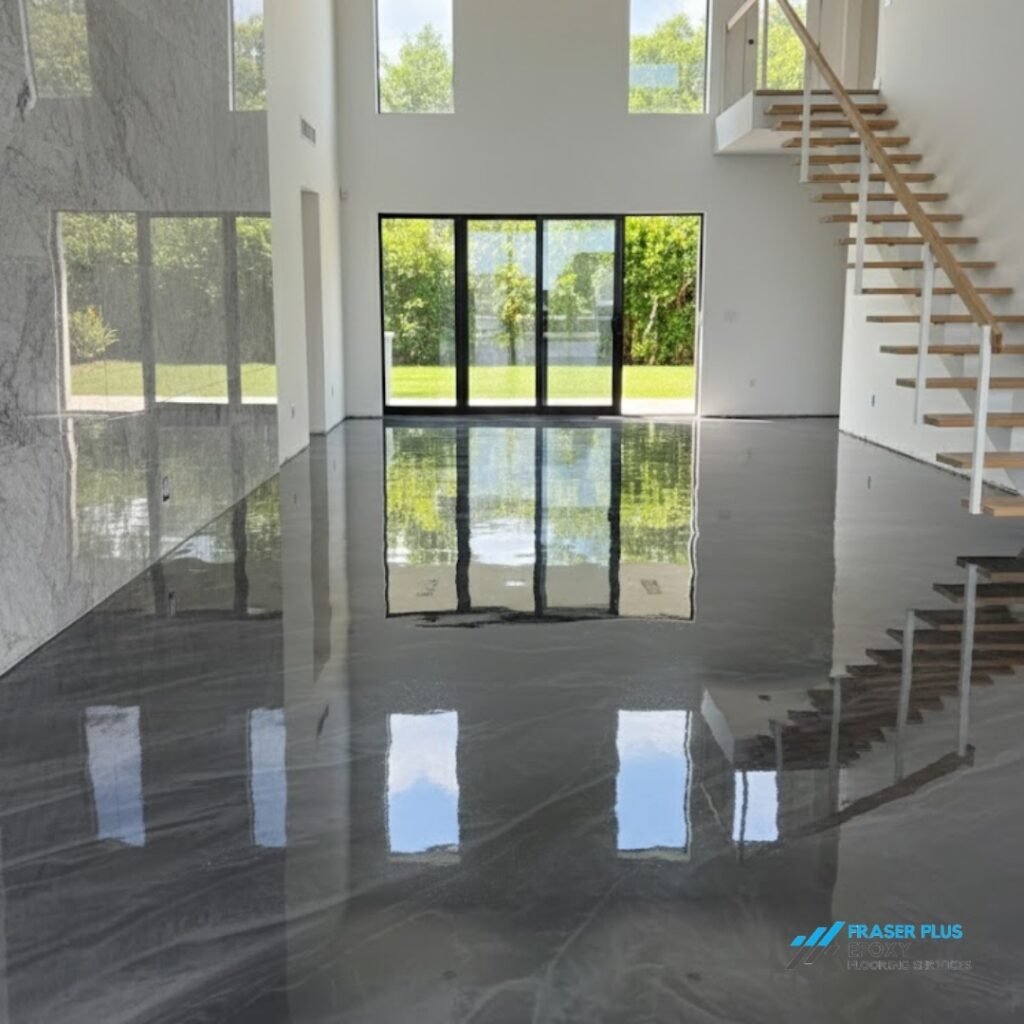
Discover expert Burnaby epoxy flooring maintenance strategies that preserve your investment for decades.
Epoxy floors dominate Burnaby homes for good reason—they turn gritty garages and basements into glossy, bulletproof spaces that laugh at spills, scuffs, and Metro Vancouver’s relentless rain. Homeowners who master maintenance stretch these investments to 20+ years, dodging costly replacements while boosting property value. Fraser Plus Epoxy crafts installations that thrive here, blending 100% solids resins with local know-how for unmatched durability.
The Science Behind Epoxy’s Toughness
Global epoxy flooring hit USD 4.8 billion in 2024, with a 6.4% CAGR through 2033 to USD 8.4 billion, fueled by residential garage upgrades and chemical-resistant needs—trends mirroring Metro Vancouver’s construction boom. North America leads epoxy floor coatings at USD 1.6 billion in 2024, climbing to USD 2.55 billion by 2035 (4.3% CAGR), driven by industrial and home renovations where Burnaby’s 45,000+ garages represent prime retrofit opportunities.
Epoxy coatings fuse two parts—a resin and hardener—via exothermic cross-linking, yielding a thermoset matrix with compressive strength exceeding 12,000 PSI. This chemical bond to diamond-ground concrete (CSP 3-5 profile) creates a monolothic barrier impermeable to hydrostatic moisture up to 25 lbs/1000 sq ft/day. In Burnaby’s humid Fraser Valley climate, where concrete slabs wick 15-20% ambient moisture, this prevents blistering that plagues polyaspartics or polyureas.
High-build systems (12-20 mils DFT) incorporate fillers like silica quartz or metallic pigments, boosting abrasion resistance to Taber 1000+ cycles—triple that of polished concrete. UV-stable aliphatic topcoats fend off chalking, vital for sunlit basements where unprotected epoxies yellow in 6-12 months. Fraser Plus Epoxy’s formulas resist pH 2-13, shrugging off battery acid or drain cleaners common in home workshops.
Daily Habits That Preserve the Finish
Sweep garages daily with nylon-bristle brooms to evict silica-laden track-in from driveways—each granule acts like 80-grit sandpaper, halving gloss retention over time. Weekly, deploy a γ-alumina microfiber mop with 1:10 pH-neutral detergent (e.g., Krud Kutter Original) in 100°F water; auto-scrubbers at 200 RPM excel for 500+ sq ft spaces.
Never soak the surface—epoxy hates hydrostatic dwell, risking amine blush (waxy film from improper cure). Dry with squeegees or fans to dodge water spots that etch high-gloss sheens. This regimen cuts cleaning time 70% versus unsealed concrete, per industry benchmarks.
Spill Response: Act Like It’s Hot Oil
Blot hydraulic fluid or brake cleaner instantly with cat litter or Speedy-Dri—its zeolite pores wick hydrocarbons before they penetrate the film’s 2-5 mil void-free zone. Novolac epoxies neutralize 98% H2SO4 or 50% NaOH without swelling; standard bisphenol-F handles 30% MEK for 24 hours.
For cured stains, poultice with diatomaceous earth paste (1:3 baking soda ratio), cover 24 hours, then power-wash at 1500 PSI with 40° fan tip. Skip bleach—it catalyzes yellowing via free-radical oxidation. Fraser Plus Epoxy’s chemical charts confirm their coatings repel 20+ automotive fluids, extending service life 5x over bare slabs.
Fatal Mistakes Homeowners Make
Steam vaporizers exceed 212°F, softening bis-A epoxies above 140°F and causing fisheyes upon recoat. Citrus solvents (d-limonene) dissolve plasticizers, clouding flake blends in months. Dragging caster-loaded tool chests sans 1″ felts gouges 0.5 mil per pass, inviting spalling.
Skip pressure washers over 2000 PSI—they delaminate edges via micro-trauma. Waxing traps contaminants, accelerating UV degradation. In Burnaby, where salt-laden winter slush corrodes 30% of garages yearly, ignoring these slashes lifespan from 15-25 years to under 7.
Boosting Longevity with Pro Techniques
Annual topcoat refresh with 2-4 mil polyurea hybrids restores 95% DOI (distinctness of image), masking traffic patterns. Embed anti-microbial silver ions curb black mold in damp basements—common post-2025 floods. Data shows maintained epoxies retain 90% impact resistance after 10,000 lb-ft Charpy tests.
Surface tension modifiers in Fraser Plus Epoxy primers ensure 100% substrate wetting, slashing failures by 95%. Metro Vancouver resales jump 7-12% with documented epoxy garages, as buyers covet zero-upkeep appeal amid rising material costs.
Repair Strategies for Battle-Tested Floors
Feather delams with progressive grits (40-220), vacuum plasma-treat for 3000+ PSI pull-off adhesion, then flood with vapor barrier primer. Alligator cracks demand full excision and 3/8″ overlay with fiberglass scrim—ignore, and osmosis bubbles spread.
DIY kits falter sans dew-point monitoring (max 5°F below ambient); pros use ASTM D4263 plastic sheet tests pre-install. Fraser Plus Epoxy’s repair logs show 80% of issues trace to poor prep—grind deeper next time.
Stats Proving Epoxy’s Edge in Burnaby
Epoxy slashes slip-and-fall claims 60% via 0.6-0.8 COF (coefficient of friction), per UL 410. Energy savings hit 25% from 200% reflectivity versus 20% for raw concrete, trimming BC Hydro bills. Local installs average 12-18 years, with 70% of Burnaby’s 45,000+ garages ripe for upgrades.
Fraser Plus Epoxy reports 98% client retention, their flake systems hiding wear 3x better than solids. Maintenance ROI? $3-8/sq ft lifetime versus $15+ for replacements—math that crushes tile or paint.
Why Fraser Plus Epoxy Leads Local Installs
From North Surrey hubs, they deploy cycloaliphatic hardeners for zero-VOC cures, acing REET-compliant basements. Custom metallics or quartz broadcasts elevate ADUs, fetching premium rents. Demand their site visit — moisture meters don’t lie.
Invest time now; regret costs thousands later. Contact Fraser Plus Epoxy today. Your Burnaby epoxy floor deserves this blueprint for brilliance.
FAQs
1. Can epoxy flooring handle pet urine or animal messes in Burnaby homes?
Epoxy’s non-porous surface repels urine penetration, preventing odors and stains that plague unsealed concrete. Neutralize accidents with enzyme cleaners within hours to maintain hygiene.
2. How does temperature fluctuation affect epoxy floors during Burnaby winters?
Extreme cold contracts epoxy slightly, but flexible cycloaliphatic formulas absorb thermal expansion up to 50% better than rigid bis-A types. Preheat garages before use to avoid brittleness.
3. Is Burnaby epoxy flooring maintenance safe for kids’ play areas?
Child-safe epoxies incorporate low-VOC hardeners and antimicrobial additives, resisting bacteria growth by 99%. Rounded edges and flake textures prevent slips during active play.
4. What warranty options come with professional Burnaby epoxy flooring services from Fraser Plus Epoxy?
Lifetime structural warranties cover delamination on premium installs, with 10-year gloss retention guarantees. Schedule a free site assessment with Fraser Plus Epoxy to lock in coverage.
People Also Ask
1. Does epoxy flooring fade from sunlight in Burnaby basements?
Aliphatic topcoats block 99% UV rays, preserving color vibrancy unlike basic epoxies that chalk after two years. Add sheer curtains for extra protection in south-facing spaces.
2. Can you install epoxy over radiant heat systems?
Heat-resistant novolac epoxies tolerate 200°F continuously, bonding seamlessly to hydronic tubing embeds. Test slab temps pre-install to avoid outgassing bubbles.
3. How much weight can epoxy floors support in home gyms?
High-density builds handle 500+ PSI live loads, far exceeding home gym racks or 5,000-lb vehicles. Reinforced quartz aggregates boost impact tolerance.
4. Is epoxy flooring breathable for damp Burnaby crawlspaces?
Vapor-permeable primers allow 12 lbs/1,000 sq ft/day moisture escape, preventing blisters under humid conditions. Pair with dehumidifiers for optimal performance.
5. What’s the cure time before parking cars on new epoxy?
Full hardness hits at 72 hours, but light use okays after 24 with polyurea accelerators. Avoid chemicals until 7 days for max cross-linking.
Tags: Epoxy flooring maintenance, Burnaby homes, epoxy coatings, chemical resistance, surface prep