
Why Diamond Grinding Machines Matter for Your Concrete Project
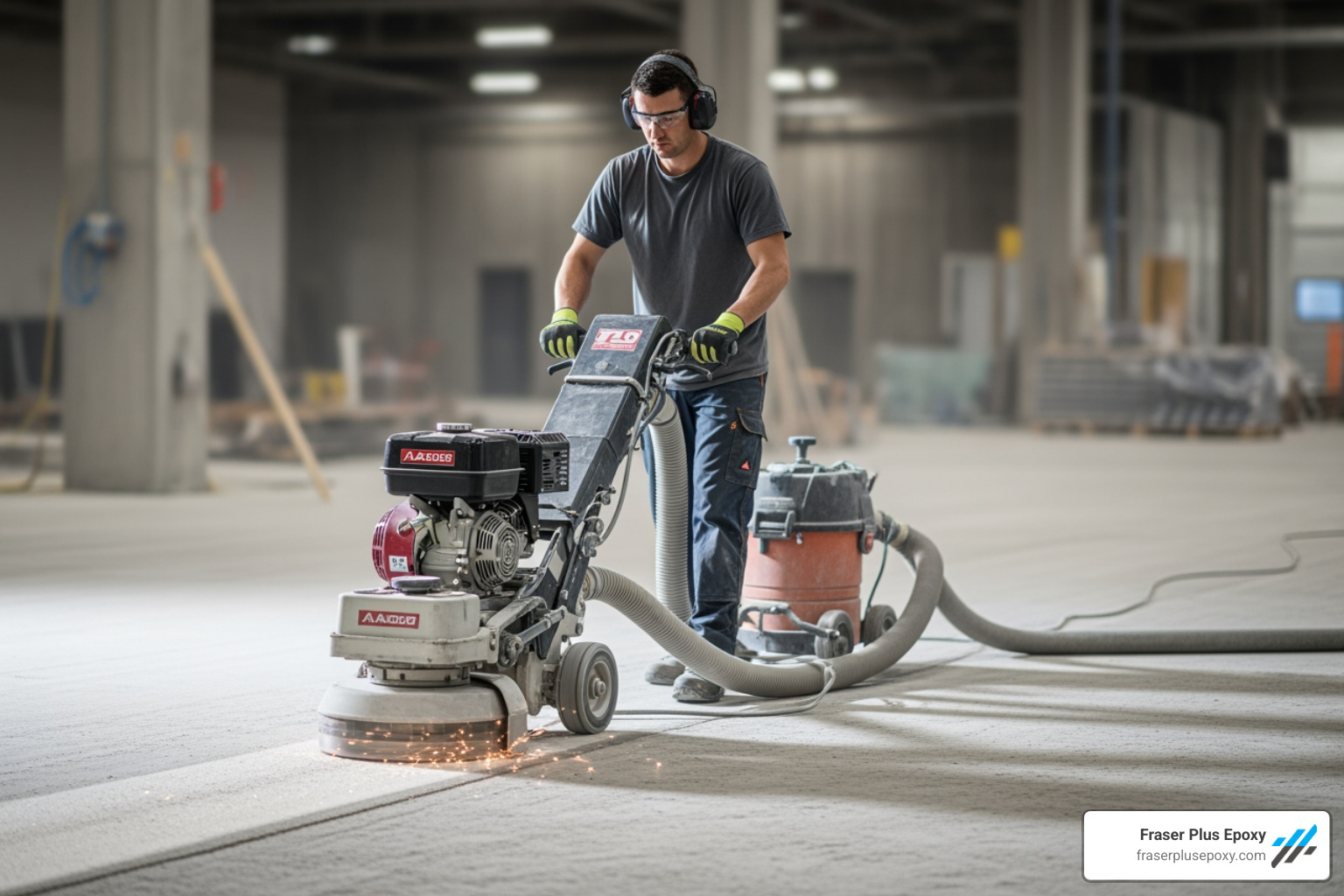
A diamond grinding machine is a specialized piece of equipment that uses diamond-embedded abrasives to grind, smooth, level, and polish concrete surfaces. These machines range from small hand-held grinders for edges and tight spaces to large walk-behind planetary models capable of processing thousands of square feet per day.
Quick Guide to Choosing a Diamond Grinding Machine:
| Machine Type | Best For | Grinding Width | Typical Applications |
|---|---|---|---|
| Hand-Held Grinder | Edges, walls, small repairs | 4-7 inches | Detail work, prep around columns |
| Single-Disc Grinder | Small to medium floors | 8-14 inches | Coating removal, light prep |
| Planetary Grinder | Medium to large floors | 13-32 inches | Polished concrete, aggressive leveling |
Concrete grinding is the foundation of nearly every successful floor coating or polished concrete project. Whether you’re removing old epoxy, leveling uneven surfaces, or creating a mirror-like finish, the right diamond grinding machine determines how efficiently you work and how good your final surface looks. According to industry data, diamond grinding can reduce project costs by up to 30% compared to other concrete rehabilitation techniques, while delivering superior smoothness and surface texture.
I’m Sunny Sidhu, founder of Fraser Plus Epoxy, and over the past decade we’ve used diamond grinding machines on hundreds of commercial and residential projects in Vancouver and Metro Vancouver—from warehouse floors requiring aggressive coating removal to showroom spaces demanding high-gloss polished concrete finishes. Choosing the right machine has always been the difference between a job that flows smoothly and one that becomes a costly struggle.
Understanding the Fundamentals of Concrete Grinding
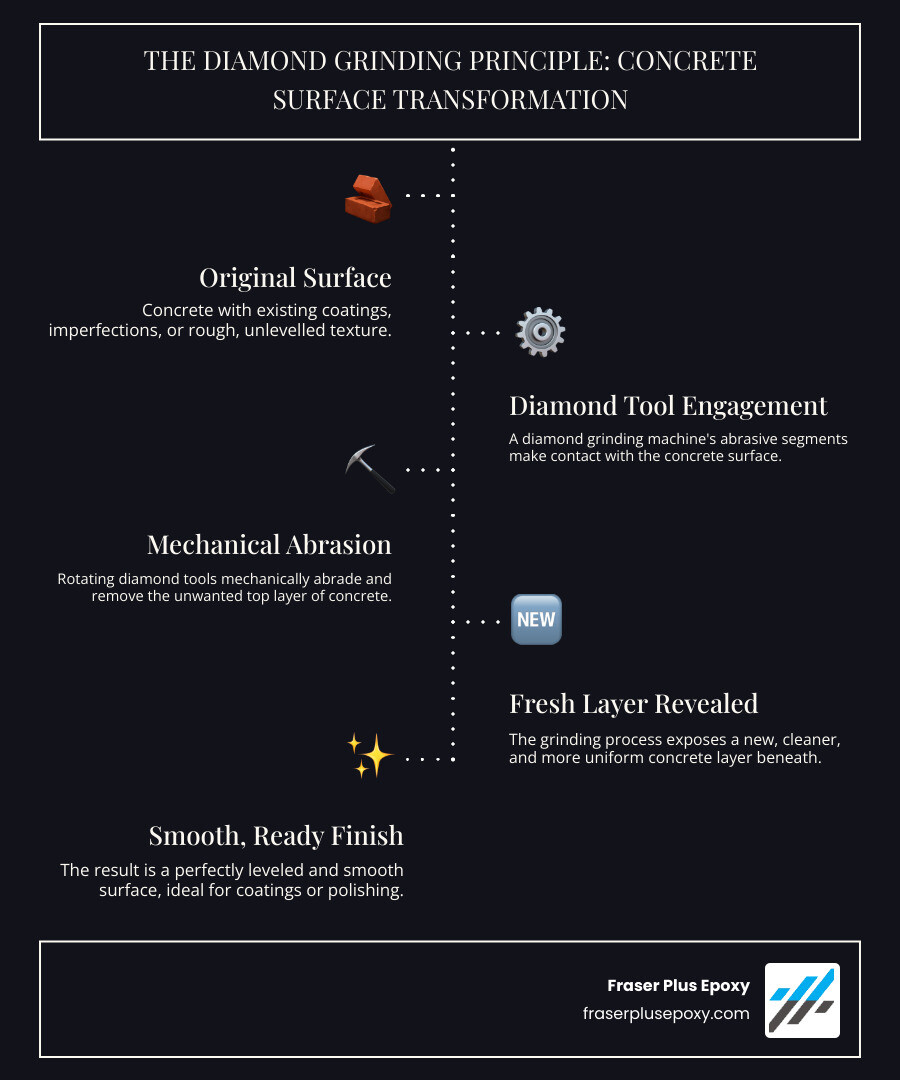
At its core, a diamond grinding machine is a workhorse designed to transform concrete by mechanically abrading the surface with industrial diamonds. We rely on these machines daily across our projects in Burnaby, Coquitlam, and Richmond to prepare surfaces for new finishes or remove imperfections.
Every machine is built around a powerful motor (electric or propane), which drives grinding heads where the diamond tooling attaches. A robust dust shroud is also crucial for capturing airborne particles and maintaining a clean, safe workspace.
How a diamond grinding machine works
Similar to sanding wood, a diamond grinding machine uses rotating heads fitted with diamond segments to chip away at the concrete surface. This controlled abrasive process removes a thin layer of material, allowing us to:
- Level uneven surfaces: Eliminating high spots for a consistent plane.
- Remove coatings: Stripping away old epoxy, paint, mastic, or glue.
- Expose aggregate: Revealing the stone within the concrete for a decorative finish.
- Smooth and polish: Progressively refining the surface with finer diamonds to achieve the desired sheen.
Modern grinders feature advanced technology like planetary drive systems, flexible “floating” heads, and variable speed controls. These innovations allow for greater precision and efficiency, preventing scarring or gouging, even over cracks and joints. This attention to detail is vital for delivering superior results for our clients in places like Surrey and Langley.
Key Components and Technologies
Understanding the key components helps in appreciating the machine’s capabilities:
- Motors: Electric motors are ideal for indoor, dust-controlled environments, while propane engines are perfect for large, open-air sites without readily available power.
- Grinding Heads: These circular plates hold the diamond tools. Machines can have single, dual, or multiple (planetary) heads for different levels of aggression and finish.
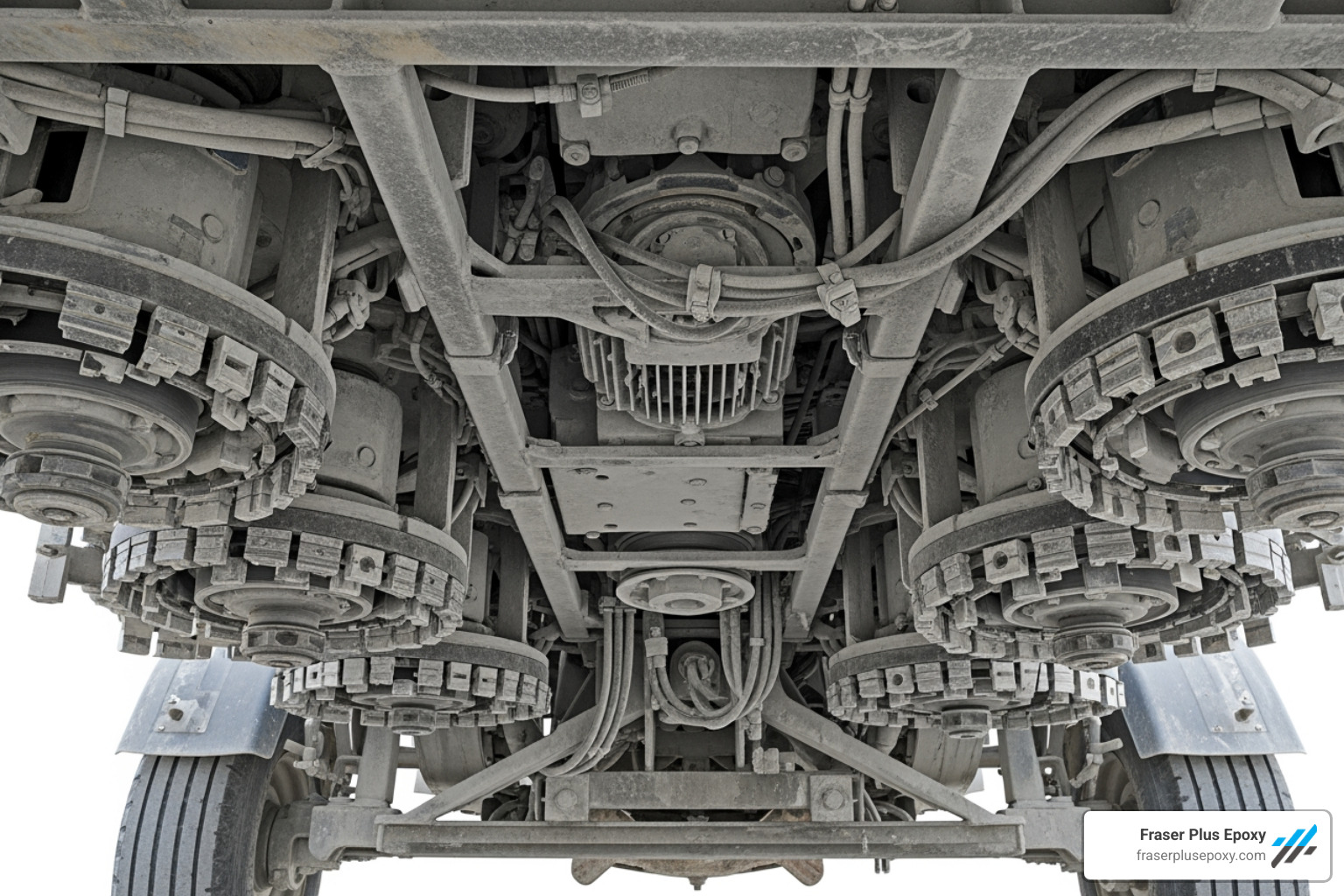
- Planetary Drive Systems: The main head rotates in one direction while smaller satellite heads spin in the opposite direction. This counter-rotation ensures even grinding, prevents swirl marks, and is essential for high-quality polished concrete.
- Flexible Grinding Heads: These heads flex or float, allowing diamonds to maintain optimal contact with uneven surfaces and prevent gouging.
- Dust Shroud and Vacuum Ports: The shroud encases the grinding heads, directing dust into an industrial vacuum for a virtually dust-free operation, which is critical for silica dust safety.
- Integrated Water Tanks: Many machines have onboard water tanks for wet grinding, which cools the diamonds, reduces dust, and can create a smoother finish.
- Variable Speed Control: This allows operators to adjust the grinding speed—slower for aggressive removal, faster for fine polishing.
Compared to other methods like shot blasting (which is often too aggressive for fine leveling) or scarifying (which can leave a rough surface), diamond grinding offers superior smoothness and versatility. From aggressive coating removal to delicate polishing, a single machine can achieve a wide range of finishes simply by changing the diamond tooling, making it a cost-effective solution for many of our Vancouver projects.
A Grinder for Every Job: Types of Diamond Grinding Machines
Just as you wouldn’t use a sledgehammer to hang a picture, you wouldn’t use a massive planetary grinder for a small bathroom floor. Choosing the right diamond grinding machine depends heavily on the scope and nature of your project. Here in Greater Vancouver, we encounter a vast array of concrete surfaces, each demanding a specific approach.
Hand-Held and Edge Grinders
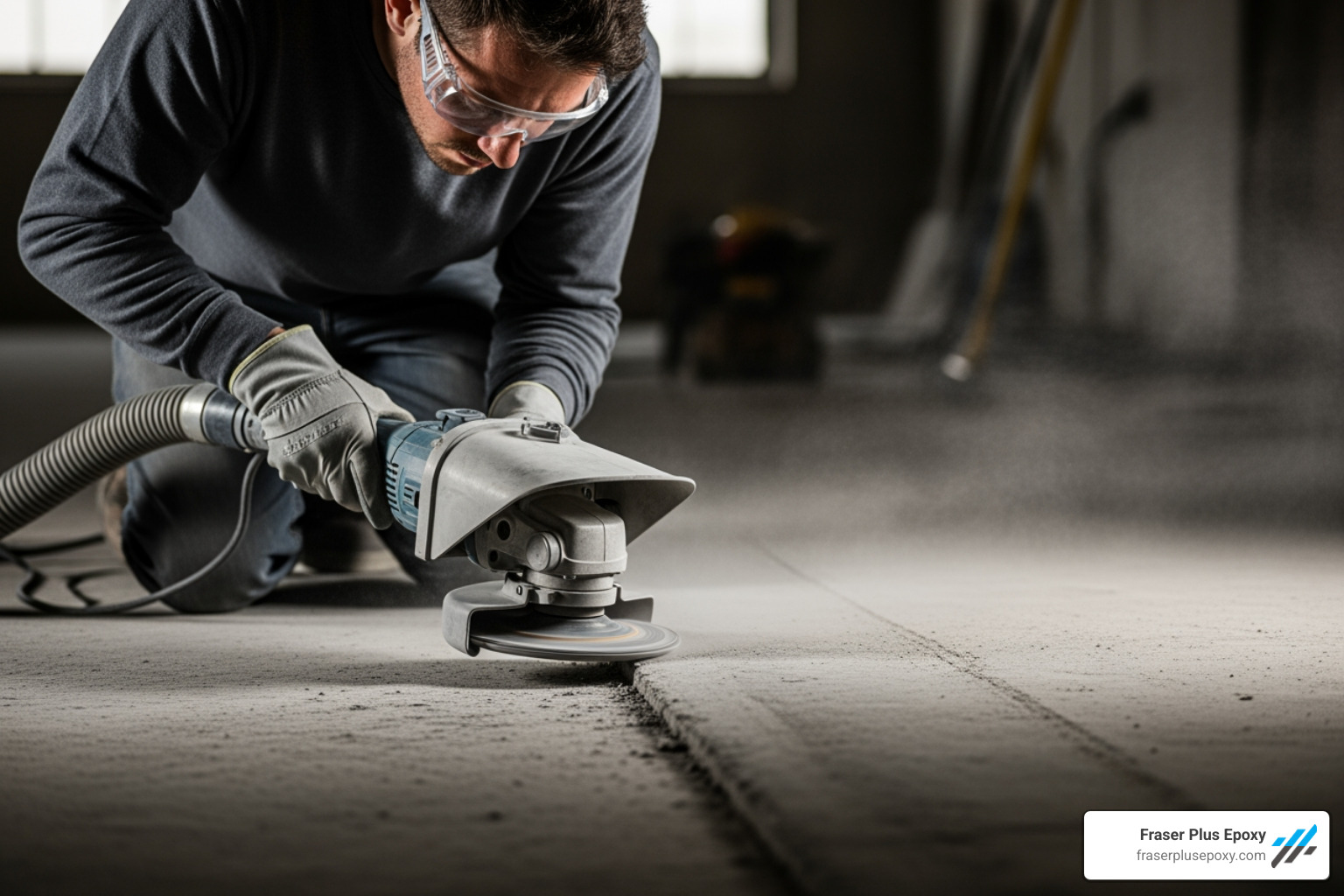
These are the nimble members of our grinding family, essential for tackling the intricate details that larger machines can’t reach.
- Small-scale projects: Ideal for residential garage floors, small commercial spaces, or tight corners.
- Edge work: Critical for grinding right up to walls, columns, and other vertical surfaces, ensuring a seamless finish across the entire floor. Some designs can grind within an inch of a vertical surface!
- Wall grinding: Yes, they can even grind concrete walls and ceilings to remove formwork marks or prepare for coatings.
- Tight spaces: Perfect for bathrooms, utility closets, or around permanent fixtures.
- Cup wheels: These grinders typically use diamond cup wheels, which are smaller, circular diamond tools designed for aggressive material removal or smoothing in confined areas.
Walk-Behind Single and Dual-Disc Grinders
Stepping up in size and power, these machines are your go-to for many medium-sized projects.
- Small to medium projects: Suitable for areas ranging from a few hundred to a couple of thousand square feet.
- Coating removal: Highly effective for stripping thin coatings, sealers, or paint from concrete.
- General surface prep: Excellent for roughening smooth concrete to ensure proper adhesion for new coatings or for light leveling.
- Simpler operation: Generally easier to maneuver and operate than their larger planetary cousins, making them a good choice for less experienced operators or less complex jobs.
Walk-Behind Planetary Grinders
These are the powerhouses of the diamond grinding machine world, built for serious work and stunning results.
- Medium to large floors: Indispensable for vast commercial warehouses, retail spaces, or industrial facilities where efficiency and a high-quality finish are paramount. We routinely deploy these on large projects across Delta, New Westminster, and Port Coquitlam.
- Polishing applications: The gold standard for polished concrete. Their planetary action ensures an even, swirl-free finish that can be refined to a high sheen.
- Aggressive material removal: Capable of quickly grinding down high spots, removing thick coatings, or preparing badly damaged concrete.
- Swirl-free finish: The counter-rotating heads eliminate the unsightly swirl marks that can be left by single-disc machines, which is critical for decorative and polished finishes. These machines can cover significant ground, with some systems capable of restoring 5,000+ square feet per night with a single grinder, or even 40,000-50,000 square feet in a few nights with two grinders!
To help you visualize the differences, here’s a quick comparison:
| Machine Type | Project Size | Primary Use | Finish Quality |
|---|---|---|---|
| Hand-Held Grinder | Small, detail work | Edging, spot removal | Good for localized areas |
| Single/Dual-Disc Grinder | Small to medium | Coating removal, light prep | Good, may require care to avoid swirls |
| Planetary Grinder | Medium to large | Polishing, aggressive leveling, coating removal | Excellent, swirl-free, high-gloss potential |
The Heart of the Grind: Selecting the Right Diamond Tooling
The most powerful diamond grinding machine is only as effective as the diamond tooling attached to it. The diamonds are the “teeth” of the grinder, and choosing the right set is paramount for efficiency, quality, and achieving the desired surface finish.
Understanding Diamond Bonds and Grits
Diamond tooling is a complex combination of diamond particles and a bonding agent, designed for different types of concrete.
- Bond Hardness: This is the hardness of the matrix holding the diamond particles. The rule is simple: use a soft bond for hard concrete and a hard bond for soft concrete.
- Soft Bond: Used for hard concrete. A soft bond wears away faster, exposing new, sharp diamond particles more quickly.
- Hard Bond: Used for soft concrete. A hard bond wears away slower, preventing the diamonds from being released too quickly on an abrasive surface.
- Diamond inserts are often color-coded to identify the bond hardness for a specific concrete Mohs scale rating (e.g., black for soft, blue for medium, gold for hard). Matching the bond to the concrete is crucial for efficiency and tool life.
- Grit Size: This refers to the size of the diamond particles, measured in mesh. Lower numbers are coarser, and higher numbers are finer.
- Coarse Grits (e.g., 16, 30/60 grit): Used for aggressive material removal, leveling, removing thick coatings, and exposing aggregate. They cut quickly but leave a rough profile.
- Medium Grits (e.g., 80, 100, 200 grit): Used to refine the surface after coarse grinding, remove scratches, and begin the smoothing process.
- Fine Grits (e.g., 400, 800, 1500, 3000 grit): Used for honing and polishing. A floor isn’t truly “polished” until at least 800 grit, with mirror-like finishes reaching 3000 grit.
The right combination of bond and grit ensures the diamond grinding machine works efficiently. You can explore a wide range of options at Diamond Grinding Tools.
Types of Diamond Abrasives
Diamond tooling comes in various forms for specific tasks:
- Metal Bond Diamonds: The most common type for initial grinding and aggressive removal. The diamonds are embedded in a durable metal matrix. We use these to remove coatings and level floors on projects across North Vancouver and West Vancouver.
- Polycrystalline Diamond (PCD): These specialized tools don’t grind—they “shave” or “chip” material off. They are incredibly effective for removing stubborn epoxies, urethanes, and mastics that metal bond diamonds struggle with.
- Resin-Bond Pads: Once the concrete is ground and densified, we switch to these flexible pads for honing and polishing. They use fine-grit diamonds (100 to 3000 grit) to achieve the desired sheen and clarity in polished concrete.
- Ceramic Pucks/Pads: These hybrid tools can bridge the gap between metal and resin tools and are sometimes used as a first step for certain finishes, but they require careful operation at lower speeds.
- Diamond Cup Wheels: Used with hand-held grinders, these are small, aggressive tools for edge grinding and detail work.
The choice of diamond tooling directly dictates the machine’s efficiency, the quality of the cut, and the final appearance of the concrete. Selecting the correct diamonds is key to achieving everything from a rough profile for coating adhesion to a high-gloss, mirror-like polished finish.
How to Choose the Right Diamond Grinding Machine for Your Project
Selecting the ideal diamond grinding machine is easier when you consider a few critical factors. Our experience with projects across Vancouver has taught us that matching the machine to the job saves time, money, and headaches.
Project Size and Surface Condition
This is the most important consideration.
- Square footage: For small areas like a residential basement, a hand-held or single-disc grinder may suffice. For large commercial spaces, planetary grinders are essential for efficiency.
- Coating thickness: Removing thick epoxy or multiple layers of paint requires an aggressive machine and tooling, like a planetary grinder with PCD segments. A single-disc grinder may be enough for thin sealers.
- Cracks and joints: The concrete’s condition influences machine choice. Grinders with floating heads can steer imperfections without gouging the surface, ideal for older floors in Vancouver’s industrial buildings.
- Levelness of the floor: A heavy-duty planetary grinder is necessary to flatten floors with significant dips or humps, often requiring multiple passes with coarse diamonds.
- Desired Concrete Surface Profile (CSP): This scale (1-10) describes surface texture. A low CSP (1-2) is smooth for polishing, while a high CSP (7-9) is rough for thick coatings. Your target CSP dictates the grinding approach.
Wet vs. Dry Grinding Applications
The choice between wet and dry grinding affects dust control, tool life, and cleanup.
- Dry Grinding:
- Benefits: Easier cleanup (dust is vacuumed) and often quicker setup. Modern dry grinding systems are highly efficient.
- Implications: Generates significant silica dust, necessitating robust dust extraction systems and HEPA vacuums to maintain a safe environment, a priority on our job sites in Burnaby and Coquitlam.
- Wet Grinding:
- Benefits: Keeps diamonds cool, extends tool life, produces less airborne dust, and can result in a smoother finish.
- Implications: Creates a concrete slurry that must be properly contained, collected, and disposed of according to environmental regulations, which can be a complex cleanup process. Wet grinding is often specified for large-scale projects to achieve precise textures and control dust.
Power, Portability, and Cost Considerations
These practical factors impact logistics and budget.
- Power Source Availability:
- Electric: Ideal for most indoor projects where 220V or 480V outlets are accessible. They produce no emissions.
- Propane: Essential for large industrial sites or areas without reliable electrical access, but they require good ventilation.
- Machine Weight: Heavier machines provide more down pressure for more aggressive grinding but are less portable.
- Purchase vs. Rental Costs: Renting may be economical for occasional projects. For contractors, purchasing offers long-term savings.
- Tooling Cost per Square Foot: Diamond tooling is a significant ongoing cost. Understanding the expected lifespan of different diamonds on your specific concrete type is crucial for accurate bidding and cost management.
Best Practices for Operation, Safety, and Maintenance
Operating a diamond grinding machine requires skill, safety adherence, and diligent maintenance. These practices ensure high-quality results, protect our team, and preserve our equipment across Vancouver and Metro Vancouver.
Safety and Dust Control
Safety is paramount, especially when dealing with concrete dust.
- Personal Protective Equipment (PPE): Always wear safety glasses, hearing protection, sturdy work boots, and gloves.
- Respirators: Concrete grinding generates fine crystalline silica dust, a known health hazard. High-efficiency respirators (N95 or better) are mandatory.
- Silica Dust Hazards: We adhere strictly to WorkSafeBC regulations regarding crystalline silica exposure, which mandate specific dust control measures to protect workers.
- HEPA Vacuums and Dust Extractors: Our grinders are always connected to industrial-grade dust extractors with HEPA filters. These vacuums capture up to 99.97% of airborne particles, creating a virtually dust-free work environment.
- Wet Grinding Considerations: While wet grinding reduces airborne dust, the resulting slurry must be managed carefully to prevent environmental contamination and slip hazards.
Basic Maintenance and Troubleshooting
Regular maintenance is key to preventing costly breakdowns.
- Daily Checks: Before each use, inspect for loose bolts, damaged cables, and worn components. Check the dust shroud and vacuum hoses.
- Belt Tension: For belt-driven machines, ensure drive belts are properly tensioned to prevent inefficient grinding and premature wear.
- Tooling Wear: Constantly monitor diamond tooling. Worn-out diamonds are inefficient and can damage the concrete or the machine.
- Cleaning the Machine: After each use, thoroughly clean the grinder to remove all dust and debris, which prevents overheating and mechanical issues.
- Common Problems and Resolutions:
- Uneven Grinding: Caused by worn tooling or improper pressure. Check tooling and adjust machine settings.
- Swirl Marks: Often a result of single-disc grinders. Planetary grinders prevent this. If using a single-disc, ensure even passes.
- Poor Material Removal: Could indicate worn diamonds or the wrong bond for the concrete. Assess tooling and machine settings.
- Excessive Dust: Points to a compromised dust shroud or clogged vacuum filters. Inspect, clean, and seal as needed.
- Warranties: Most equipment comes with a manufacturer’s warranty against defects, but this rarely covers normal wear or misuse, highlighting the importance of proper operation and maintenance.
Diamond Grinding Machine: Achieving Professional Results
A diamond grinding machine is a powerful tool for changing concrete surfaces, from basic preparation to a high-gloss polish. Selecting the right machine and tooling is the first step toward a successful project. With the right equipment, combined with an understanding of concrete characteristics and grinding techniques, you can achieve remarkable results, whether it’s preparing a floor for a new coating or creating a stunning polished concrete finish.
For projects requiring a flawless, durable finish in Vancouver, Burnaby, Richmond, or anywhere in Metro Vancouver, the expertise of a professional team makes all the difference. Fraser Plus Epoxy specializes in creating stunning polished concrete and epoxy floors, utilizing state-of-the-art equipment and techniques. We bring over 10 years of experience to every project, ensuring your concrete surfaces are prepared and finished to the highest standards. Learn more about our professional epoxy flooring solutions.